
Election Commissioners Flag Centralised Control of Voter Software
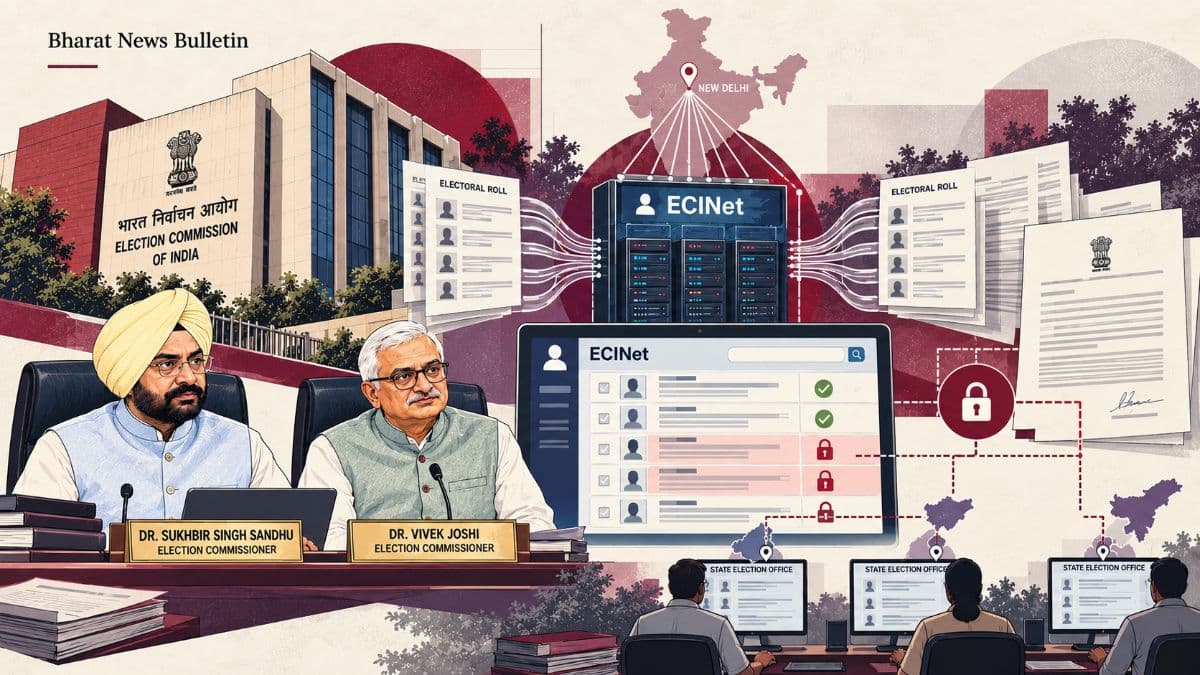
An Indian Express investigation says Election Commissioners Sukhbir Singh Sandhu and Vivek Joshi repeatedly raised concerns that centralised control of ECINet and its predecessor ERONet was restricting statutory powers of election officers responsible for electoral rolls.
Two Election Commissioners raised repeated concerns over the centralisation of India's electoral-roll database and the functioning of the Election Commission's voter-management software, according to an investigation by The Indian Express.
Election Commissioners Sukhbir Singh Sandhu and Vivek Joshi recorded concerns that Electoral Registration Officers and other statutory authorities responsible for preparing voter rolls did not always have the access or software functionality needed to exercise their legal powers. On three occasions, their notes were copied to Chief Election Commissioner Gyanesh Kumar, the report said.
KEY ISSUE
ERO has the statutory authority to add, delete and decide claims concerning voters in an Assembly constituency.The commissioners' concern, according to the investigation, was that centralised software controls could restrict how those statutory powers were exercised in practice.
The issue centres on ECINet, launched by the Election Commission on January 22, 2026 as an integrated digital platform bringing together more than 40 existing election-related applications and portals. The Commission had presented the platform as a system designed to improve transparency, credibility and public trust.
The Indian Express investigation says concerns about centralised software control actually predated ECINet. Its predecessor, ERONet, was already being used for electoral-roll management as new modules were introduced for the Special Intensive Revision.
Under the Representation of the People Act, 1950 and Registration of Electors Rules, 1960, responsibility for an Assembly constituency's electoral roll rests with its Electoral Registration Officer. EROs consider claims and objections and decide on additions and deletions to the rolls.
According to correspondence reviewed by The Indian Express, Deputy Election Commissioner Sanjay Kumar wrote to senior officials on November 4, 2025, acting on Sandhu's directions, that statutory functions of EROs, District Election Officers and Chief Electoral Officers had to be exercised by those officials themselves and that IT systems should comply with the law.
On January 2, with the SIR underway across 12 states and Union Territories, Kumar again wrote to the IT division seeking to ensure that the system did not restrict an ERO's discretion. ECINet was launched 20 days later.
Concerns escalated on April 16, when Sandhu recorded that several new IT modules and portals had been developed without being brought to his knowledge or presented before the Commission, according to the investigation. He asked that the IT division keep all members informed and obtain necessary approvals before undertaking new activities.
On May 29, Joshi raised what he described as the "gradual centralisation of the electoral roll database." He proposed an audit involving an outside expert, including potentially from an IIT, to verify that only legally authorised officials had credentials capable of making changes to the voter database.
TIMELINE OF INTERNAL CONCERNS
Nov 4, 2025 — Warning that IT systems must not restrict statutory election officers
Jan 2, 2026 — IT division asked to preserve ERO discretion
Apr 16 — Sandhu flags new IT modules developed without his knowledge
May 29 — Joshi proposes audits over database centralisation
July 29 — Both commissioners separately write to the Cabinet Secretary
Aug 14 — Sandhu records detailed concerns over access controls
Joshi proposed two checks. One would periodically verify that only statutory authorities possessed credentials to change the voter database. Another would examine whether ECINet complied with electoral law and ensure that policy and procedural changes were placed before the Commission.
Sandhu endorsed the proposal on July 13 and said it should be placed before the Commission. But on August 14, he recorded that he did not know what action had been taken on the proposals submitted by the two commissioners, according to The Indian Express.
The dispute intensified following an internal administrative change on July 28.
Until then, Deputy Election Commissioner Sanjay Kumar had oversight of the IT division's work and routed its files to the three-member Commission. When Senior Deputy Election Commissioner Maneesh Garg received additional charge of administration, he changed the work allocation and removed Kumar's oversight of the Director General of IT, the investigation reported.
The following day, Sandhu and Joshi separately wrote to Cabinet Secretary T V Somanathan, describing the order as a violation of the law governing the Commission and seeking appropriate action against Garg, according to documents reported by The Indian Express.
On July 30, the two commissioners jointly set aside the revised work allocation and directed that the previous arrangement continue until the Commission reached consensus on a change. Their communication was also copied to CEC Gyanesh Kumar.
UNUSUAL ESCALATION
The two Election Commissioners separately approached the Cabinet Secretary on July 29 over an internal work-allocation order affecting oversight of the Election Commission's IT division. The next day, they jointly set that order aside.
Sandhu recorded his most detailed concerns on August 14. According to the investigation, he wrote that CEOs, DEOs and EROs were the statutory authorities responsible for electoral rolls, but several officials had told him they lacked "proper and complete access" to ERONet.
He attributed this to centralised access controls at the Director General of IT level and argued that the IT division did not have legal authority to restrict the access and operational freedom granted to statutory election officers by law. These were Sandhu's recorded assertions as reported by The Indian Express, not a judicial finding that the system violated the law.
He sought immediate full access for the relevant officers and asked the IT division to certify, based on confirmations from state Chief Electoral Officers, that election authorities across states and Union Territories could perform their statutory duties without software restrictions.
The dispute highlights a distinction between legal decision-making authority and technical control. While the ERO may legally decide whether a voter should be added, deleted or restored, the investigation describes instances in which the digital system allegedly limited the actions that officers could execute themselves.
That issue was also illustrated by the separate Goa SIR case, where state election officials determined that 97 previously excluded voters were eligible, but repeatedly sought a software rollback facility before publication of the final roll.
The Indian Express said it contacted the Election Commission as well as Sandhu and Joshi for responses to the issues raised in this part of its investigation but received no response before publication.
The findings are therefore based on internal notes and correspondence reviewed by The Indian Express and its reporting across multiple states. They document concerns raised within the Election Commission itself, but do not by themselves establish that electoral rolls were improperly altered or that any individual centrally manipulated voter records.
The larger issue now concerns how India's increasingly centralised election technology should interact with the decentralised statutory structure under which individual EROs are legally responsible for preparing and maintaining electoral rolls.