
97 Eligible Goa Voters Remained Off Final Roll
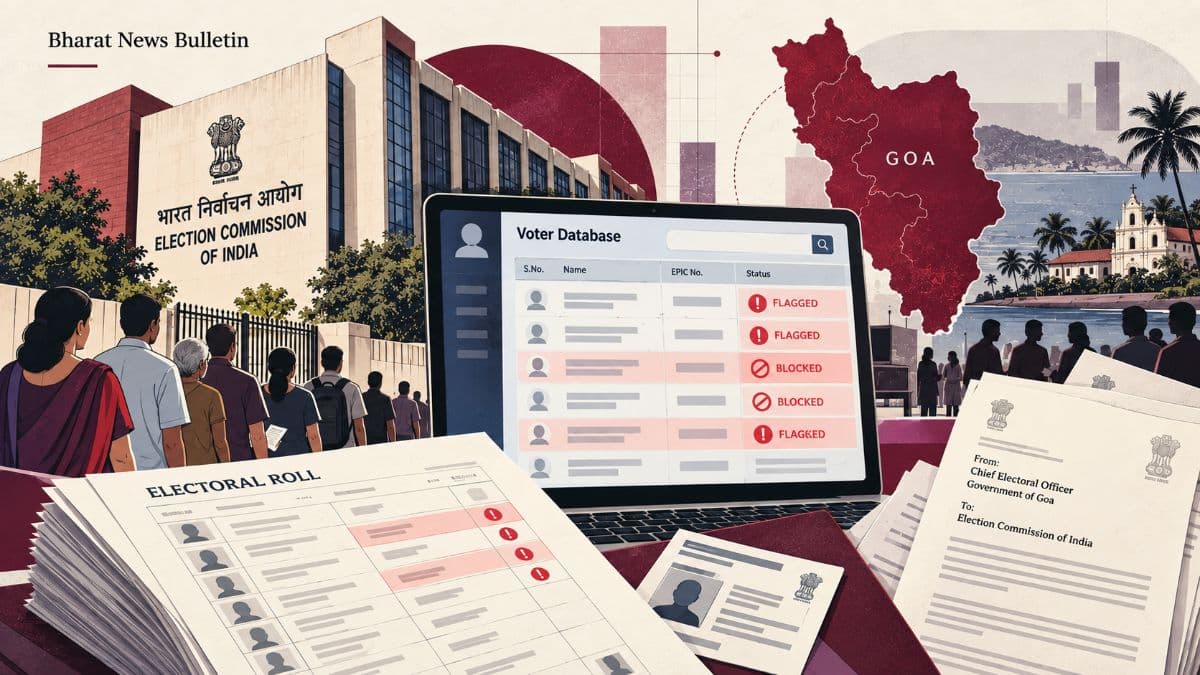
Goa election officials sent eight requests in seven days seeking an ECINet rollback facility after 97 voters were found eligible, but their names were still absent when the final SIR electoral roll was published, an Indian Express investigation has found.
Ninety-seven voters in Goa remained excluded from the state's final electoral roll despite local Electoral Registration Officers finding them eligible for inclusion, according to an investigation by The Indian Express that raises questions about the centralised control of the Election Commission's ECINet software.
The report says Goa's Chief Electoral Officer and other state election officials repeatedly contacted the Election Commission of India in Delhi because the software did not provide the required rollback or reversal functionality to restore the voters.
Between February 11 and February 17, Goa officials sent eight emails or requests over seven days seeking the functionality. The final SIR electoral roll was published on February 21 without the 97 names. The Indian Express reported that it checked the roll and found all 97 were still absent as of September 20.
GOA SIR SNAPSHOT
97 voters — Found eligible by local election officials but absent from the final roll
8 requests in 7 days — Sent by Goa officials seeking software action
February 21 — Final Goa SIR roll published
September 20 — All 97 were still missing, according to The Indian Express's verification
The issue began with voters identified by the system as having "logical discrepancies." Such discrepancies can include mismatches involving a parent's name, unusual parent-child age gaps, inconsistencies between old and current electoral records, or certain documentation issues. Being flagged does not itself establish that a person is ineligible to vote.
On January 29, the Supreme Court directed that people flagged for such discrepancies be informed of the reason and given an opportunity to submit documents or objections and be heard. Although the order concerned proceedings involving Tamil Nadu, the court said it expected the procedural directions to be followed in other states where SIR was underway. The Election Commission subsequently issued instructions for implementation.
In Goa, 649 electors came forward with documents or objections following that process. Electoral Registration Officers and Assistant Electoral Registration Officers examined the cases and concluded that 97 people had become eligible for inclusion in the final roll and that their earlier exclusion decisions needed to be reversed, according to correspondence reviewed by The Indian Express.
The obstacle was technical and administrative: the previous decision had already been recorded on ECINet, while the local officials reportedly lacked access to a rollback option that would allow them to reverse it.
Goa Electronics Limited, which assists the state's Chief Electoral Officer with the software, wrote on February 11 that the necessary rollback and document re-upload functionality had still not been provided despite multiple previous communications.
WHY THE 97 NAMES COULD NOT BE RESTORED
Local EROs examined the affected cases and determined that the voters should be included. However, according to the correspondence reported by The Indian Express, ECINet did not give them the functionality needed to reverse the earlier recorded decision, requiring intervention from the Election Commission's central IT setup.
The urgency escalated as publication of the final electoral roll approached. On February 17, Goa's Chief Electoral Officer sent Delhi the list of 97 cases and requested action to include them in the final SIR roll.
On February 18, Deputy Election Commissioner Sanjay Kumar also intervened. According to the correspondence cited in the investigation, he told the Election Commission's IT division that EROs and AEROs had statutory powers to take corrective action and that the IT system could not block action required under the Supreme Court's directions.
Despite that intervention, the final electoral roll was published three days later without the 97 voters.
Goa Chief Electoral Officer Sanjay Goel told The Indian Express that the state had informed the ECI about cases that needed to be included after being flagged for logical discrepancies. He said the decision not to include them was the Commission's, while also arguing that ECINet should provide a mechanism allowing voters to be restored at the ERO level.
The episode has broader significance because electoral rolls are legally prepared constituency by constituency by Electoral Registration Officers, while the digital infrastructure used to maintain those rolls is now operated through the Election Commission's centralised ECINet platform.
The Indian Express linked the Goa episode to concerns previously recorded by Election Commissioners Sukhbir Singh Sandhu and Vivek Joshi about the centralisation of electoral-roll systems. Joshi had raised concerns about what he described as the "gradual centralisation" of the database, while Sandhu questioned restrictions on the access available to EROs, District Election Officers and Chief Electoral Officers.
The Election Commission, responding separately to The Indian Express's broader investigation into internal objections, said that differing observations were a normal part of institutional deliberations and that decisions taken by the Commission over the past year were ultimately unanimous decisions of the full Commission.
The Indian Express said it also sought an explanation from the Election Commission's Director General of IT, Seema Khanna, on why the rollback facility was not enabled in Goa before publication of the final roll, but reported receiving no response.
The consequences in Goa potentially extend beyond participation in elections. The state's Mediclaim Scheme uses voter status as an eligibility condition and provides assistance for specified specialised treatments, meaning exclusion from the electoral roll can have implications beyond the ability to cast a ballot.
The episode therefore puts focus on a wider institutional question: whether technological controls within a centralised electoral-roll system can prevent statutory officers on the ground from implementing decisions they are legally authorised to make.