
China Economy Grows 4.5% on Strong Exports
Export growth supports the world's second-largest economy, but weak domestic demand and mounting trade tensions remain key challenges.
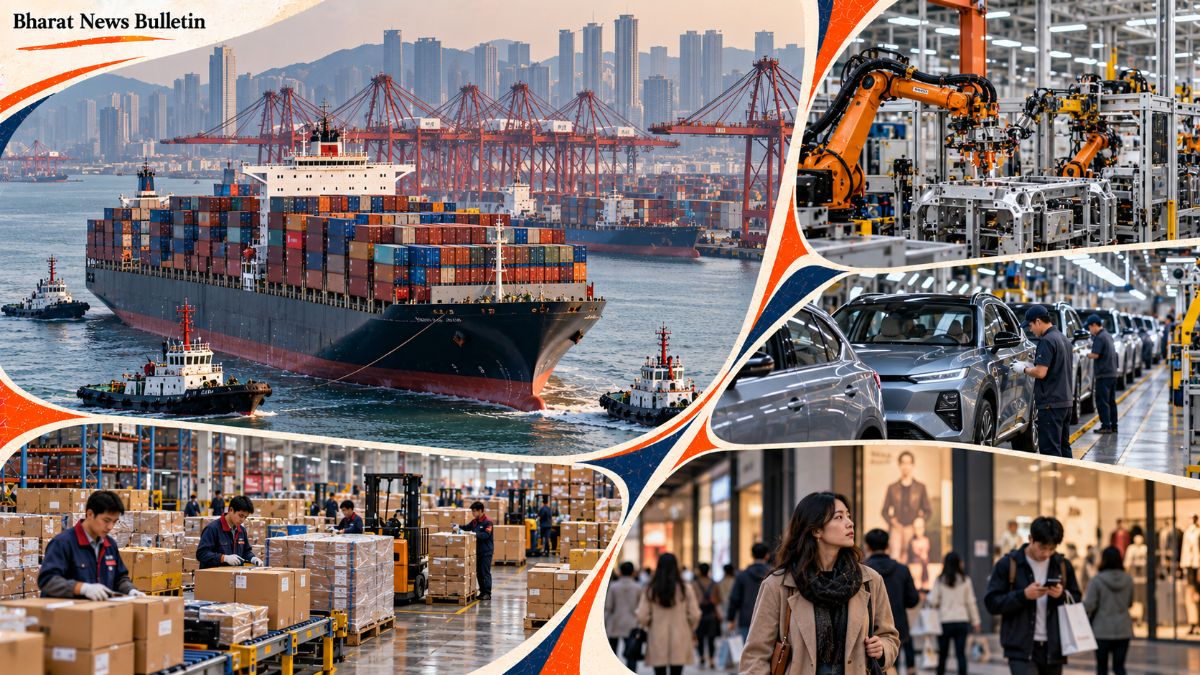
China’s economy grew 4.5% year-on-year in the July-September quarter of 2026, accelerating from 4.3% growth in the April-June period, according to official figures reported by The Associated Press. Growth for the first three quarters of the year reached 4.6%, bringing Beijing closer to its full-year target of 4.5% to 5%.
Robust exports have been a major contributor to economic activity, helping offset persistent weakness in domestic consumption and the prolonged property-market downturn. Economists cited by AP cautioned that strong headline growth does not necessarily reflect conditions across all industries, regions and households.
China recorded export growth of 36% in September and had accumulated a global trade surplus of $938 billion between January and September. The country is on track to exceed its record annual trade surplus of $1.2 trillion recorded last year, according to the report.
Higher US tariffs have affected some bilateral trade between Washington and Beijing, prompting Chinese exporters to expand sales in other markets, including Southeast Asia, Latin America and Europe. High-technology products, including semiconductors, automobiles, hybrid vehicles and electric vehicles, have supported export performance.
China’s manufacturing expansion has also increased the supply of goods such as solar equipment and electric vehicles. With domestic consumption remaining subdued, producers have increasingly relied on overseas markets to absorb output, adding to concerns among trading partners about competition from lower-priced Chinese imports.
The European Union has become a prominent source of pressure for trade rebalancing. Chinese exports to the EU rose 16% during the first nine months of 2026, while the bloc continues to face a substantial trade deficit with China. The two sides have also reached an agreement intended to roughly halve the number of Chinese hybrid-vehicle imports over the coming years.
China’s National Bureau of Statistics acknowledged that insufficient domestic demand remains a prominent problem and that the foundation for a sustained economic recovery needs strengthening. The International Monetary Fund recently lowered its 2026 growth forecast for China to 4.5%, the lower end of the government’s target.
Economists have also warned that an export-dependent growth model may not generate broad employment and income gains at the same pace as output. Beijing has said it wants to expand domestic demand and has called for cooperation between economies running trade surpluses and those facing deficits. However, trade barriers and pressure from trading partners are likely to remain important challenges for China’s growth outlook.