
India's First LNG-Powered Train to Launch From Sabarmati
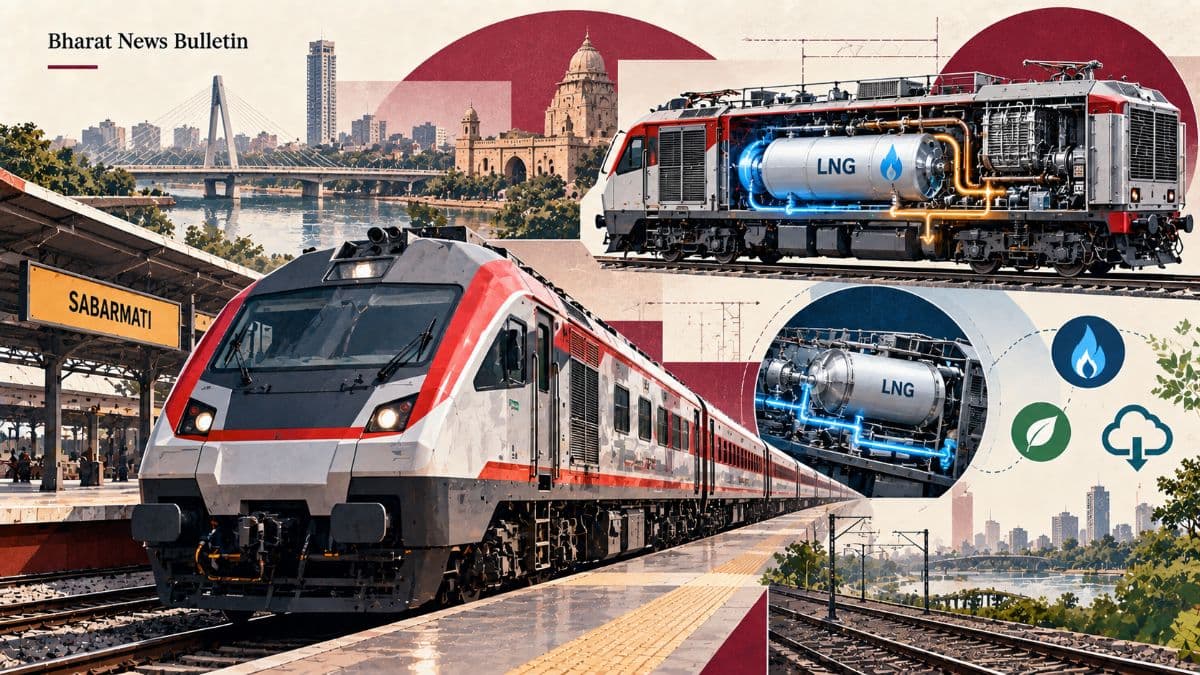
Amit Shah will flag off India's first LNG-diesel dual-fuel train from Sabarmati Station, introducing a system that can replace around 40% of diesel use while lowering emissions and operating costs.
India is set to take a significant step towards cleaner railway transportation with the launch of the country's first LNG-powered train from Sabarmati Station on September 27.
Union Home and Cooperation Minister Amit Shah will flag off the train, which uses a Liquefied Natural Gas-diesel dual-fuel system developed for Indian Railways' Driving Power Cars.
The train is not designed to run exclusively on LNG. Instead, its modified engines can operate using both LNG and diesel, allowing LNG to substitute around 40% of conventional diesel consumption while retaining diesel as an alternative when LNG is unavailable.
LNG TRAIN SNAPSHOT
2 × 1,400 HP — Driving Power Cars converted
Up to ~40% — Diesel that can be replaced by LNG
2,000+ km — Field trials already completed
₹23.9 lakh — Estimated annual fuel saving for an eight-coach rake
Under the project, Indian Railways has converted two Driving Power Cars, each rated at 1,400 horsepower, to operate using the LNG-diesel dual-fuel system.
The two modified power cars have already completed more than 2,000 kilometres of field trials, during which the Railways evaluated the reliability and performance of the technology.
A key advantage of the dual-fuel configuration is operational flexibility. The engine can continue running on diesel when LNG is unavailable, reducing the risk that the alternative-fuel system could interrupt normal train operations.
Indian Railways also expects the technology to help lower emissions. Replacing part of the diesel consumption with LNG can reduce pollutants including carbon dioxide, nitrogen oxides and particulate matter, making the system potentially cleaner than conventional diesel-only operation.
Fuel costs are another important part of the project.
Based on trial data, Indian Railways estimates that one modified Driving Power Car could save approximately ₹11.9 lakh in fuel costs annually. For an eight-coach rake using two such power cars, the estimated annual saving rises to around ₹23.9 lakh.
FUEL & RANGE
~2,200 litres — LNG tank capacity in each power car
950–1,000 kg — Approximate usable LNG per tank
~444 km — Estimated daily operating range from a fully loaded LNG tank
No reduction in power — Railways says conventional engine performance is maintained
Each Driving Power Car has been equipped with an LNG tank with a capacity of around 2,200 litres, capable of carrying approximately 950 to 1,000 kilograms of usable LNG.
According to the approved design, a fully loaded tank can provide sufficient LNG for approximately 444 kilometres of daily operation, potentially reducing the frequency of refuelling.
Importantly, Indian Railways says the conversion has been designed without compromising the power, reliability or operational performance of the existing diesel engine.
The project represents the first deployment of an LNG-based fuel system in Indian Railways' Driving Power Cars and could provide a model for wider adoption if the technology delivers the expected operational, environmental and financial benefits.
The launch also forms part of Indian Railways' broader effort to introduce cleaner energy sources, improve fuel efficiency and reduce dependence on conventional diesel across its network.
The performance of the first LNG-diesel train in regular operation will therefore be closely watched before the technology is considered for wider deployment across suitable railway services.