
Supreme Court Flags Penalty for Not Singing Vande Mataram
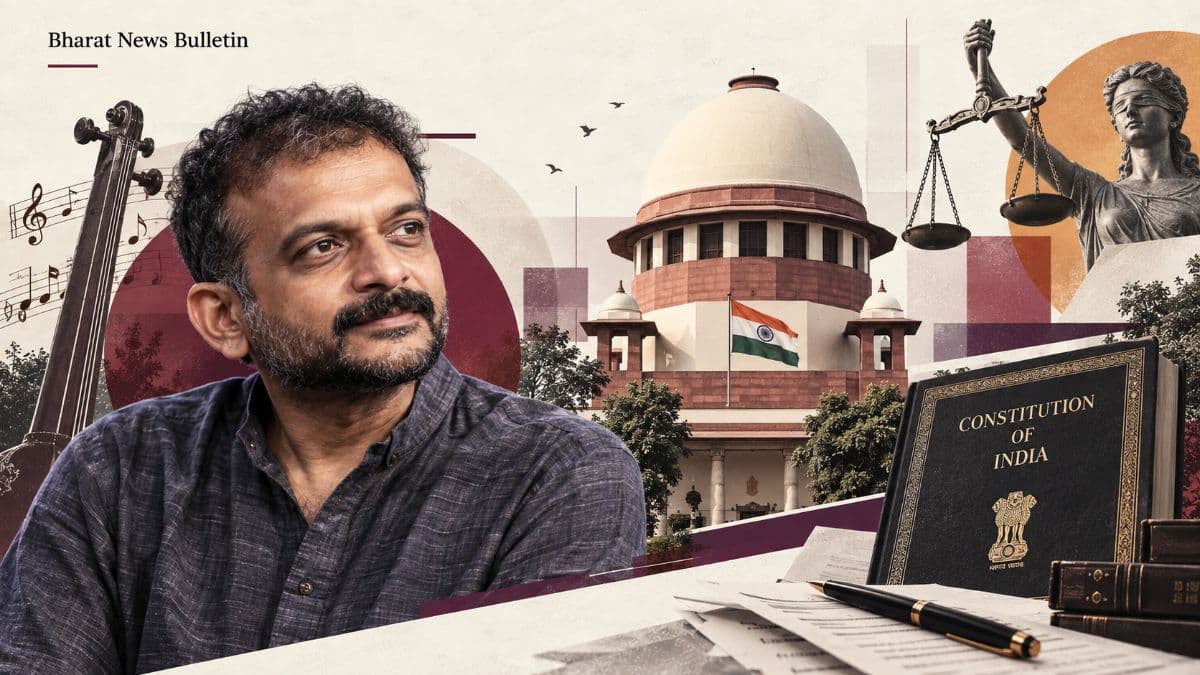
Hearing T M Krishna’s challenge, the Supreme Court said it expects the principle protecting conscientious objectors in its 1986 Bijoe Emmanuel ruling to apply, while it examines the scope of criminal consequences under the amended national honour law.
The Supreme Court has indicated that a person who conscientiously refuses to sing Vande Mataram should not face criminal consequences, while hearing Carnatic vocalist T M Krishna’s challenge to the amended law and government directions concerning the National Song.
A three-judge bench comprising Chief Justice of India Surya Kant, Justice Joymalya Bagchi and Justice V Mohana heard the petition on September 22. The court said it would examine the question of penal consequences and referred to its landmark 1986 judgment in Bijoe Emmanuel v. State of Kerala.
KEY COURT OBSERVATION
The Supreme Court indicated that a conscientious objector should not be subjected to criminal consequences for declining to sing one or all stanzas, while making clear that the precise legal issue remains under examination.
The Bijoe Emmanuel judgment concerned students belonging to Jehovah’s Witnesses who respectfully stood during the National Anthem but declined to sing it because of their religious beliefs. The Supreme Court held that punishing them in those circumstances violated their fundamental rights. During Tuesday's proceedings, Justice Bagchi said that ruling continues to represent the law of the land.
Krishna has challenged the 2026 amendment to Section 3 of the Prevention of Insults to National Honour Act, 1971, as well as Ministry of Home Affairs directions concerning the complete six-stanza version of Vande Mataram at specified official occasions. The amended provision covers intentional prevention of the singing of the National Anthem or National Song, or intentional disturbance of an assembly engaged in such singing, with punishment that can extend to three years' imprisonment, a fine, or both.
Krishna's petition argues that requiring all six stanzas raises constitutional concerns because the final four contain references to Hindu deities. His lawyers contend that imposing penal consequences in connection with such a requirement could infringe freedom of conscience and other fundamental rights. These are arguments advanced by the petitioner and have not been finally accepted by the Supreme Court.
Justice Bagchi indicated that homage to a particular God or form of God in a national song would not necessarily, by itself, undermine secularism. The bench instead identified the treatment of a conscientious objector and the extent of possible penal consequences as questions requiring examination.
WHAT THE CASE IS EXAMINING
Six stanzas — Version challenged by Krishna in relation to official directions
Up to 3 years — Maximum imprisonment under the amended provision for conduct it criminalises
1986 — Bijoe Emmanuel precedent relied upon in the hearing
Freedom of conscience — Central constitutional issue raised by the petitioner
The court also distinguished between determining what version should constitute the National Song for official purposes and deciding whether an individual can be punished for conscientious non-participation. The bench indicated that determining national aspirations associated with the song is principally for the democratically elected state, while constitutional protections for conscientious objectors remain relevant.
The hearing also witnessed a sharp exchange between Solicitor General Tushar Mehta and Senior Advocate S Muralidhar, who appeared for Krishna.
Mehta, while responding to arguments over how the law had been framed, used the expression that lawmaking could not be according to “Naxalite” ideas. Muralidhar strongly objected and asked that the remark be withdrawn. The bench said it had not taken note of the comment and would restrict itself to the constitutional issue before it.
The dispute over Vande Mataram therefore remains before the Supreme Court. The bench's comments during the hearing are oral observations rather than a final judgment on Krishna's constitutional challenge. The scope of the amended law, its interaction with freedom of conscience and the circumstances in which penal provisions can apply remain issues for judicial determination.